5 min read
LinkedIn Profile vs Resume: What Actually Changes
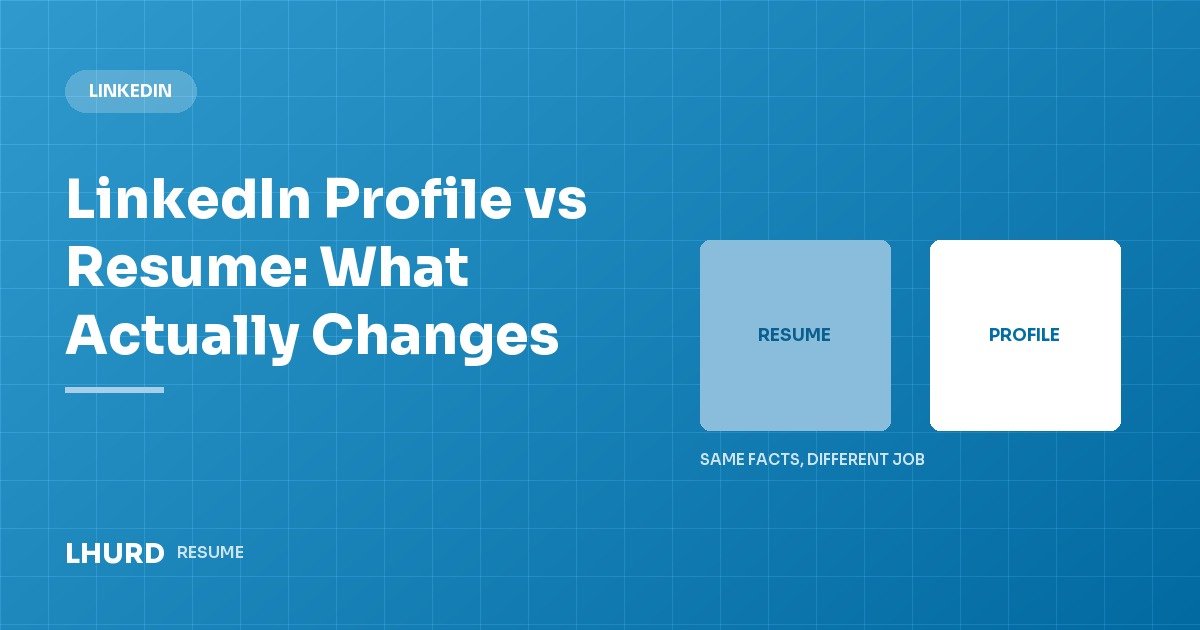
A resume is sent to one employer for one role. A profile is read by many people for many reasons, including people who were not looking for you. They cannot be the same document.
Two Documents, Two Jobs
A resume is a targeted argument. It goes to a named employer, for a named role, and every line is selected to support that one application. It is read once, quickly, by someone deciding whether to shortlist you.
A profile is a standing asset. It is searched, browsed, and checked by people at different stages of intent, most of whom arrived without being asked to. It has to do its work without knowing who is reading.
Length and Completeness
A resume cuts anything that does not serve the target role. A profile keeps far more, because you cannot know which detail matters to the person searching. An old role, a side project, or a language can be exactly the term a recruiter filtered on.
This is the single biggest mistake in pasted resumes. The cutting that makes a resume strong makes a profile invisible, because search runs on the words that are present.
Voice
A resume is written in an implied third person with the pronouns stripped out. A profile should be written in first person, because it is a human being talking to other human beings on a social platform.
The About section in particular fails when it reads like a professional summary. It is the one place you can say why you do the work, which is the part a resume has no room for.
- Write the About section in first person
- Keep the resume’s pronoun free style on the resume only
- Say why you do the work, not only what you have done
Resume Cuts, Profile Keeps
Search runs on words that are present. Cutting for focus makes a profile invisible.
First Person on LinkedIn
It is a social platform. An About section that reads like a resume summary wastes the one place you can say why.
The Headline Is Prime Space
Indexed in search and attached to every comment you make. Repeating your job title buys nothing.
Dates Must Match Exactly
Recruiters open both side by side, and a date discrepancy is what background checks flag.
The Headline Is Not the Title
A resume does not have a headline. A profile does, it is indexed heavily in search, and it follows you into every comment and message you send. Spending it on your current job title wastes the most visible line you own.
Use it to say what you do and for whom. The job title is already on the profile twice below, so repeating it in the headline buys nothing.
What Stays Identical
Dates, titles, and employers must match exactly across both. A recruiter will have the two open side by side, and a discrepancy in dates is the kind of thing that gets flagged in a background check.
Your strongest two or three achievements should also appear in both, phrased differently but describing the same facts. Consistency on substance, difference in register.
Keep It Current When You Are Not Looking
A resume is written when you need one. A profile is searched continuously, including during the long stretches when you are not applying for anything, which is when the most interesting approaches tend to arrive.
Updating it the week you start looking is also a visible signal. A profile that has been quietly maintained for years tells a different story than one rebuilt in a hurry, and recruiters can see which they are reading.
- Dates, titles and employers: identical across both
- Length and breadth: fuller on the profile, cut on the resume
- Voice: first person on LinkedIn, stripped on the resume
Need Both Working Together?
Lhurd Resume writes resumes and LinkedIn profiles as a pair, consistent on the facts and different in register, so a recruiter reading both sees one coherent professional.
Owner Lynda Hurd has written for professionals across the United States and Canada at every stage, from first promotion to executive search.
The Takeaway
Keep the facts identical and the treatment different. The resume cuts to one argument, the profile keeps breadth for search, and the voice shifts from stripped third person to first.
The headline is the single highest leverage line on the profile and the most commonly wasted. Your headline is not your job title covers it, and Lhurd Resume writes both documents together.
Join the conversation