5 min read
How to List Education on a Resume at Every Career Stage
Education belongs at the top for a graduate and near the bottom for everyone else. Getting that order wrong is one of the most common structural mistakes on a resume.
Position Is the Whole Decision
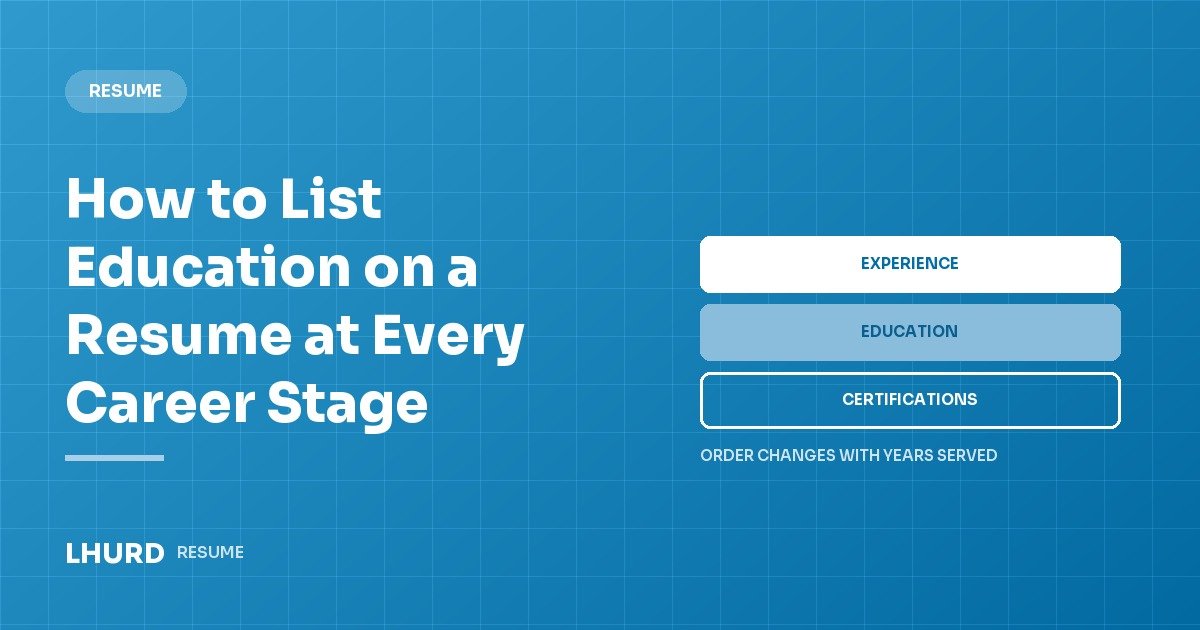
Education sits above experience while you are a student or within about two years of graduating, because it is the strongest evidence you have. After that it moves below experience permanently, and it keeps moving down as your record grows.
Leaving it at the top at year eight signals that you consider your degree your main qualification, which reads as a lack of professional progress whether or not that is true.
What Every Entry Needs
Four elements: the qualification, the institution, the location, and the year you completed it. Anything beyond that is optional and most of it should be cut.
Write the qualification the way it is formally awarded rather than in shorthand. Bachelor of Science in Mechanical Engineering, not BSc Mech Eng. Applicant tracking systems match on the full term, and shorthand can fail the filter entirely.
- Qualification, written out in full
- Institution and its city, state or province
- Year of completion
- Honours or distinction, only where genuinely strong
When to Drop the Graduation Year
Once you are more than about fifteen years past graduation, the year becomes an age marker rather than useful information. Dropping it is accepted practice and removes a data point that invites bias before anyone reads your results.
Keep the degree itself. Removing the qualification entirely creates an unexplained hole that a reader will notice, and the credential still matters. It is the date that stops earning its place.
Top for Two Years
Above experience while studying or just graduated. Below it permanently after that.
Write It Out in Full
Applicant tracking systems match the formal name. Shorthand like BSc Mech Eng can fail the filter outright.
Drop the Year at Fifteen
Past that the date is an age marker, not information. Keep the degree, lose the year.
Certifications Sit Higher
They are current and often a screening requirement. A degree from 2009 is neither.
Unfinished, In Progress and Non Degree Study
Study in progress belongs on the page with an expected completion date. Study you abandoned does not need to appear at all, and listing it invites a question you gain nothing by answering.
If you completed substantial coursework without finishing, you can state the credits or years completed honestly. What you must never do is write the degree as though it were awarded, which is the single most commonly checked claim on any resume.
Certifications Are Not Education
Professional certifications belong in their own section, usually above education, because they are current and often a screening requirement. A PMP, CPA, CFA, AWS or clinical certification is doing far more work than a degree from 2009.
Include the issuing body and the expiry or renewal date where one exists. An undated certification raises a question about whether it is still valid, which is the opposite of what the section is for.
Where Candidates Overdo It
A module list, a thesis title nobody asked about, a grade point average past your second job, secondary school once you hold a degree. Each takes space from a result that would do more for you.
The exception is a graduate with little work history, where relevant coursework carrying real keywords can legitimately earn a line. Even then it is one line, not a transcript.
- A full module or course list
- Your thesis title, unless the role is academic or research
- Grade point average, once you are past your second job
- Secondary school, once you hold any degree
- Societies and clubs, unless you led one and it shows scope
Not Sure What Still Earns Its Place?
Lhurd Resume rebuilds resumes around proof rather than credentials, deciding what leads, what shrinks, and what comes off entirely.
We work with professionals across the United States and Canada at every stage, from graduates through executive search.
The Takeaway
Put education at the top for about two years, then move it below experience and let it shrink. Write qualifications out in full, drop the year once you are well past it, and give certifications their own section higher up.
Deciding what shrinks is the same judgement as deciding how far back the whole document should go. How far back a resume should go covers it, and Lhurd Resume can make the calls with you.


Join the conversation