5 min read
How Far Back Should a Resume Go? The Fifteen Year Rule and Its Exceptions
Listing everything since your first job buries the relevant work and dates you unnecessarily. Here is where the line sits and how to handle what falls behind it.
Start With Fifteen Years
The working convention in the United States and Canada is roughly ten to fifteen years of detailed history. Beyond that, roles are compressed or dropped unless they carry specific relevance.
The reason is partly attention and partly age. A resume running back to 1998 invites a judgement about your age that has nothing to do with your ability, and it does so on the first page.
Relevance Beats Recency
Fifteen years is a default, not a rule. A role from eighteen years ago that is directly relevant to the target job belongs on the page. Three recent roles that have nothing to do with it may not.
Ask of every entry whether a hiring manager filling this specific role would be glad to see it. If the honest answer is no, it is taking space from something that would.
How to Compress Rather Than Delete
Early career history does not have to vanish. A short block at the bottom preserves the shape of your progression without spending lines on detail nobody needs.
Something like: Earlier roles: Analyst, Barclays; Associate, KPMG. 2004 to 2011. Two lines, no bullets. It shows the foundation and the institutions without inviting a line by line read.
- Keep the title and employer, drop the bullets
- Group everything pre cutoff into one block with a date range
- Keep an early role in full only if it is directly relevant to the target job
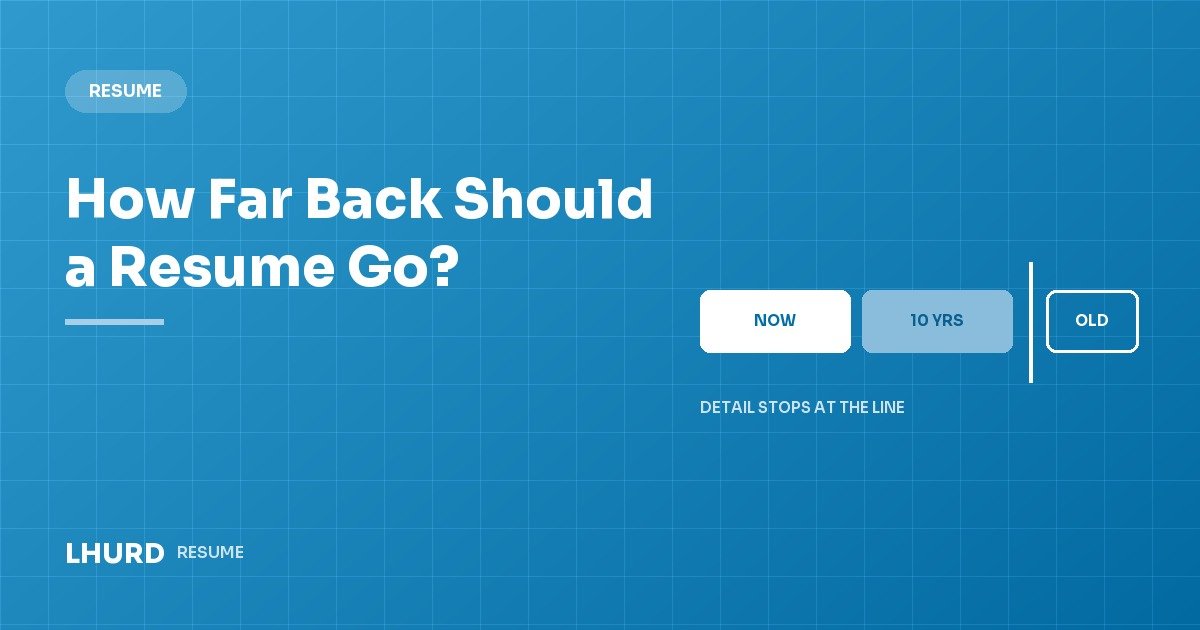
Fifteen Years, Then Compress
Detailed history to roughly fifteen years, with earlier roles grouped in a two line block.
Relevance Overrides Age
An eighteen year old role that fits the job belongs. A recent one that does not may be costing you space.
Drop the Graduation Year
Once you are well past it, the degree still earns its place on the page but the date does not.
Academia and Federal Differ
Cumulative records and USAJOBS expect far more history. A disclosure form is not a resume.
What to Cut Without Hesitation
Part time work from school, unrelated roles held before your current field, and anything held for under three months that is not explained by a contract ending. Each of these raises a question without answering one.
Graduation years are the other common giveaway. Once you are more than fifteen years out, the degree still belongs on the page but the year does not need to.
Where the Rule Does Not Apply
Academic, scientific, and medical records are cumulative by convention, and publication lists run the full length of a career. Federal applications in the United States also expect substantially more history than a private sector resume.
Security clearance and some regulated roles may require a complete employment history on a separate form. That is a disclosure document rather than a marketing one, and the two should not be the same file.
When Your Career Changed Direction
If you moved fields, the cutoff is governed by the pivot rather than by years. Work from before the change stays only where it demonstrates something the new field values, and it should be framed in the new field’s language.
Everything else from the earlier career compresses into the same two line block. A full account of a career you have deliberately left makes a reader wonder whether the move is settled.
- Pre pivot work that proves something the new field values: keep, reframed
- Everything else from the earlier career: the two line block
- A full account of a career you left: cut
Twenty Years In and Not Sure What to Cut?
Lhurd Resume works with senior professionals and executives whose records no longer fit a standard document, deciding what leads, what compresses, and what comes off.
Every resume is written by hand and formatted to pass applicant tracking systems across the United States and Canada.
The Takeaway
Fifteen years of detail, earlier work compressed into a short block, and anything irrelevant cut regardless of when it happened. The test is whether a hiring manager filling this role would be glad to see the entry.
Deciding what to cut is the same judgement as deciding how long the document should be. Resume length covers the other half, and Lhurd Resume can make the calls with you.

Join the conversation