5 min read
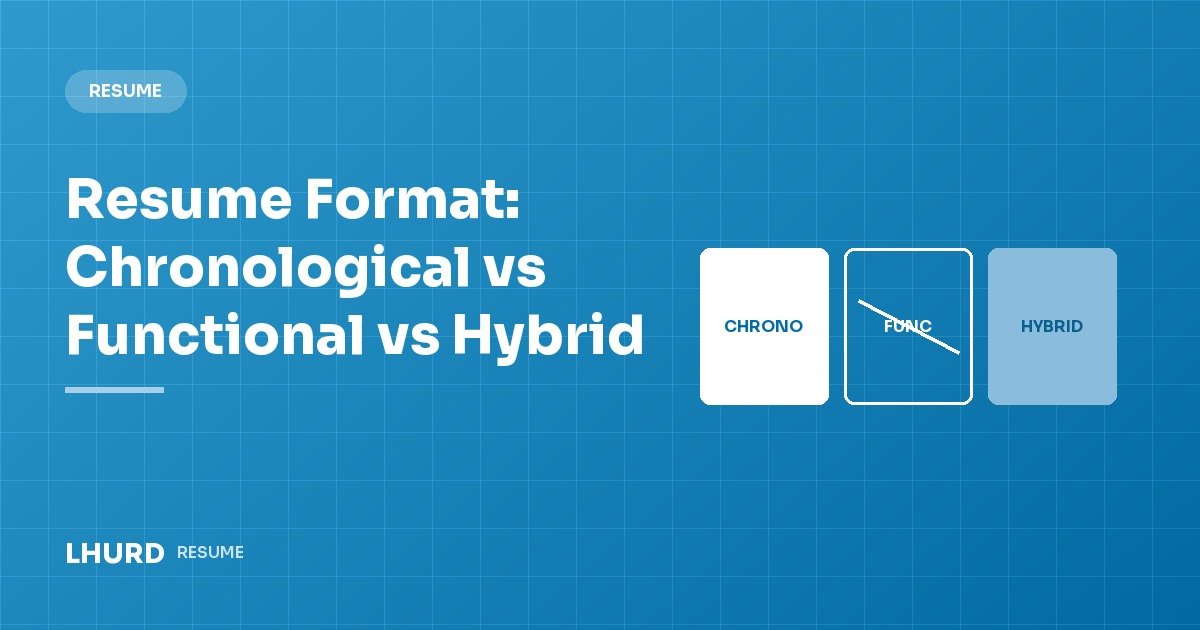
Resume Format: Chronological vs Functional vs Hybrid
Three formats exist. One of them is read as an attempt to hide something. Here is how each is actually received, and which to use at which point in a career.
Three Formats, and Only Two Worth Using
Resume format is one of the few decisions on the document that a recruiter notices before reading a single word. The shape of the page tells them how you want to be read, and whether you are confident about your record.
There are three standard options. Chronological lists roles newest first. Functional groups achievements by skill and pushes employment history to the bottom. Hybrid leads with a short capability summary, then runs chronologically.
The Chronological Resume Wins by Default
Reverse chronological order is what every applicant tracking system is built to parse and what every recruiter expects. Roles descend from most recent, each with dates, employer, title, and achievements underneath.
It works because it answers the two questions a hiring manager has immediately: what are you doing now, and does the path leading here make sense. Anything that obscures those answers creates friction you do not want.
The Functional Resume Is Read as a Red Flag
The functional format groups your abilities into themed blocks and lists employers as a bare footnote. The pitch is that it highlights transferable skill. The reality is that recruiters have learned it is most often used to disguise gaps, short tenures, or a thin record.
It also parses badly. An applicant tracking system expects achievements to sit under dated roles, and a functional layout separates them, so the system cannot attribute what you did to where or when you did it.
- Dates are separated from achievements, so the ATS cannot connect them
- Experienced recruiters read it as concealment, fairly or not
- The question it was meant to avoid gets asked in the first screening call anyway
Chronological by Default
It is what every ATS parses cleanly and what every recruiter expects. Deviate only with a reason.
Functional Signals Hiding
Recruiters associate it with gaps and short tenures, and the ATS cannot link achievements to dated roles.
Hybrid for a Pivot
A short summary plus a full dated history frames an unobvious fit without obscuring anything.
Fix the Record, Not the Shape
If you want functional because the history is awkward, address the awkward part in one line instead.
The Hybrid, and When It Earns Its Place
A hybrid opens with a short summary and a tight skills block, then runs fully chronological underneath. It gives you four or five lines at the top to frame the reader before they reach the history.
This is the right choice for a career change, for a technical role where the stack matters as much as the sequence, and for senior candidates whose breadth needs framing. The key is that the chronology is still complete and still dated.
Choosing in Thirty Seconds
If your last three roles move in a coherent direction, use chronological. If your experience is real but the connection to the target role is not obvious from job titles alone, use hybrid. Do not use functional.
If you are reaching for functional because the history looks difficult, the honest fix is to address the difficulty directly rather than hide the shape of it. A dated break explained in one line costs you far less than a format that signals evasion.
- Last three roles moving in one direction: chronological
- Real experience but an unobvious fit: hybrid
- History you would rather not show plainly: fix the record, not the format
Not Sure Which Format Your History Needs?
Lhurd Resume works with professionals across the United States and Canada whose records do not fit the standard shape, including career changers, returners, and people with non linear paths.
We choose the structure around the story your record actually tells, then build it to parse cleanly in an applicant tracking system.
The Takeaway
Use chronological unless you have a specific reason not to. Use hybrid when the fit needs framing. Avoid functional, because it parses badly and reads as concealment even when nothing is being concealed.
If the awkward part of your history is a break rather than a direction, the fix is a single explanatory line rather than a different layout. Explaining an employment gap covers exactly that, and Lhurd Resume can build the structure with you.

Join the conversation