5 min read
How to List Skills on a Resume Without Wasting the Space
The skills section is the most wasted block on most resumes. Used properly it feeds the applicant tracking system and tells a hiring manager what you operate. Used badly it lists adjectives that describe everyone.
What the Skills Section Is Actually For
The skills block has two jobs and neither is self description. First, it carries the hard keywords an applicant tracking system looks for. Second, it lets a hiring manager see at a glance what you operate without reading every bullet.
Both jobs require specifics. A list of qualities fails at both, because a system cannot match on an adjective and a manager cannot assess one.
Cut Every Adjective
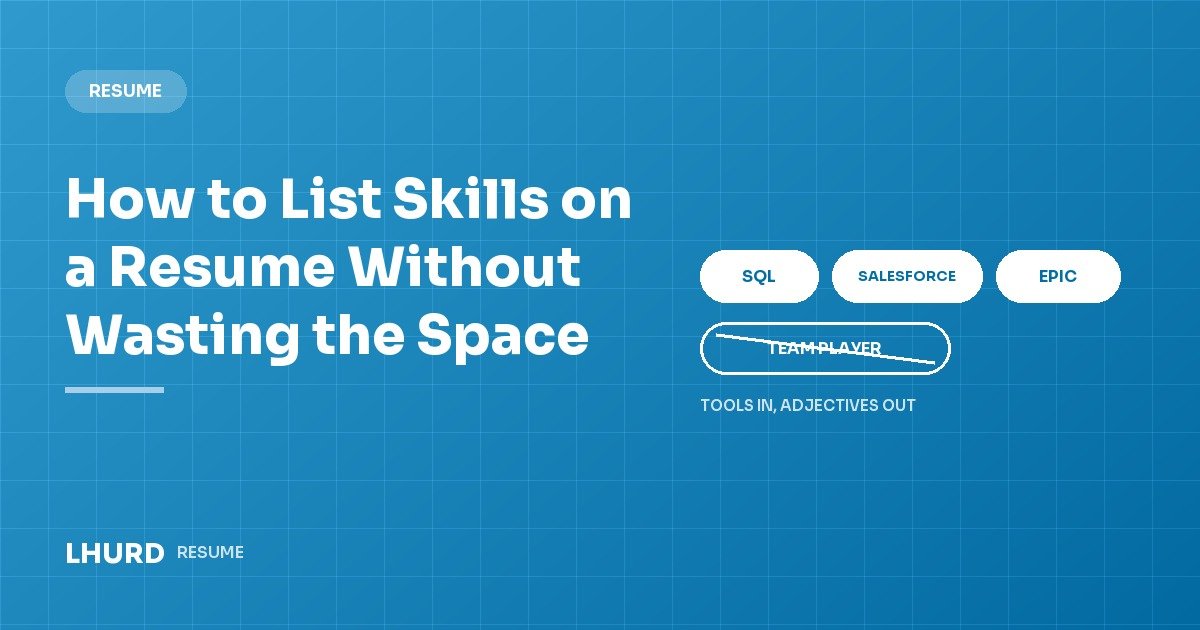
Communication skills. Team player. Detail oriented. Hard working. Self starter. Every competing applicant has written the same words, which makes them invisible to a system and meaningless to a human.
They are also unfalsifiable, and an unfalsifiable claim carries no weight. Replace each one with either a tool you use or a result that demonstrates the quality without naming it.
- Instead of detail oriented: reduced error rate from 12 to 1.4 percent
- Instead of communication skills: presented to a C suite audience of 50 plus
- Instead of team player: coordinated across engineering, legal, and operations
Group by Type, Not by Confidence
A long undifferentiated list is hard to scan. Break the section into two or three labelled groups so a reader can find what they came for: technical tools, platforms and systems, and certifications or languages.
Avoid rating your own proficiency. Star ratings, percentage bars, and labels like advanced or expert are self assessed, inconsistent between candidates, and occasionally used against you in an interview.
Adjectives Are Invisible
A system cannot match on team player and a manager cannot assess it. Name tools and methods instead.
No Self Ratings
Star bars and expert labels are self assessed and inconsistent, and they invite awkward interview questions.
Borrow the Posting’s Words
Where a requirement honestly describes your work, use their phrasing rather than your internal term.
Eight to Fifteen Entries
Past that it reads as a list of everything you have touched rather than what you operate.
Match the Posting, Honestly
The posting tells you which skills the filter is weighted toward. If a requirement appears there and genuinely describes your work, use the posting’s exact wording rather than your internal company term for it.
The line is honesty. Matching vocabulary for something you have done is good practice. Listing a tool you opened once is the kind of claim that ends badly in a technical interview.
Where the Section Belongs
For technical roles, put skills near the top, directly under the summary, because the stack is a screening criterion. For most other roles, put it after experience, because your achievements are the stronger argument.
Keep it to roughly eight to fifteen entries. Beyond that the list stops being a signal and starts reading as everything you have ever touched.
Skills Block or Bullet Point?
A tool belongs in the skills block. Evidence that you used it well belongs in a bullet under the role where you used it. Candidates routinely do one or the other and then wonder why the section feels thin.
Listing Salesforce in your skills tells a system you know it exists in your vocabulary. Writing that you rebuilt the pipeline reporting in Salesforce and cut forecast variance by a third tells a manager you can operate it. You want both, in their proper places.
One practical check before you submit. Read the skills block on its own, without the rest of the resume, and ask whether it describes a specific person doing specific work. If it would fit a hundred other applicants unchanged, it is not finished.
- Tools, platforms and systems: the skills block
- Evidence you used them well: a bullet under the role
- Certifications with issuing body and year: either, but only once
Want the Space on Your Resume Working?
Lhurd Resume rebuilds resumes so that every block earns its place, including the sections most people fill out of habit.
We work with professionals across the United States and Canada, formatting for applicant tracking systems without stripping the document of personality.
The Takeaway
The skills section earns its space when it carries real keywords and names things that could be verified. Cut adjectives, group what remains, skip self ratings, and borrow the posting’s vocabulary where it honestly applies.
Keywords matter most when you know how the filter weighs them. Using keywords without getting rejected covers that mechanic, and Lhurd Resume can rebuild the section with you.


Join the conversation