Read time: 5 min read
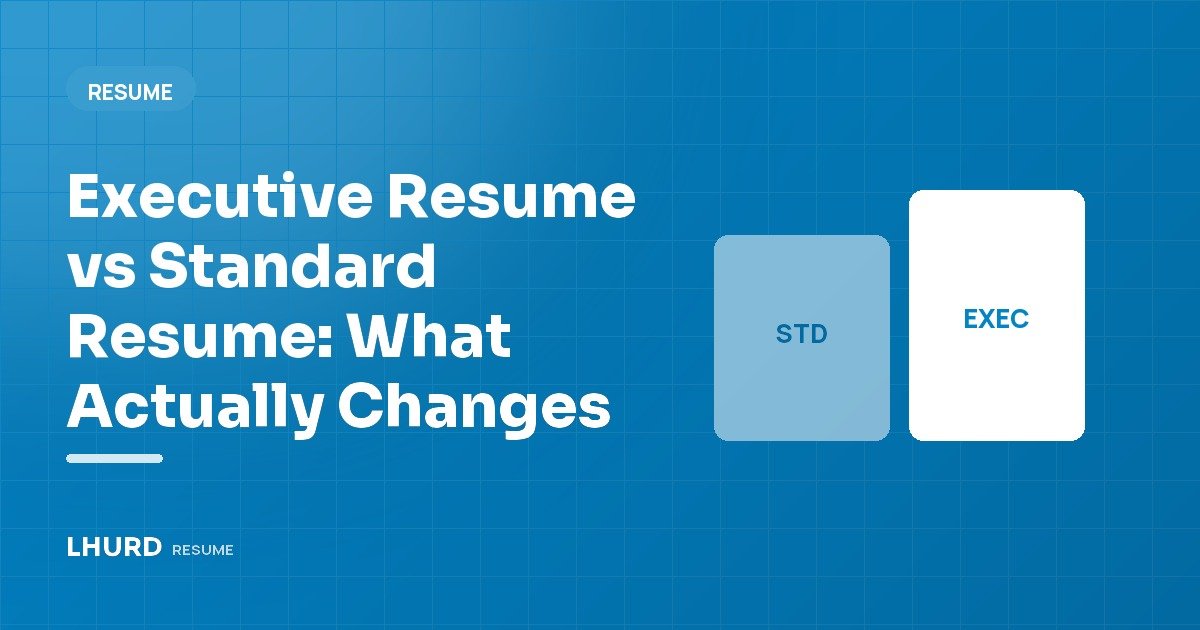
Executive Resume vs Standard Resume: What Actually Changes
Applying for a senior or C-suite role with a standard resume is one of the most common and costly mistakes in job searching. Here is exactly what separates an executive resume from an ordinary one.
Why Your Standard Resume Will Not Get You an Executive Role
At the executive level, hiring decisions are made by boards, CEOs, and executive search firms, not HR generalists. These decision makers are not screening for skills. They are evaluating leadership track record, business impact, and strategic vision. A standard resume reads like a job history. An executive resume reads like a business case.
The difference matters because the evaluation criteria are fundamentally different. When a recruiter at the HR level reviews a resume, they are looking for keywords, dates, and role progression. When a board member or executive search consultant reviews an executive resume, they are looking for proof of transformational leadership, P and L accountability, and the ability to navigate complexity at scale. A standard resume cannot tell that story.
of executive searches conducted by specialist headhunters who read differently than HR
pages maximum for executive resumes versus 1-2 for standard
time a senior recruiter spends on first scan of executive document
The Five Real Differences Between Executive and Standard Resumes
Length. Standard resumes are 1 to 2 pages. Executive resumes can be 2 to 3 pages because the depth of experience demands it. At the executive level, you have more to say and more value to prove.
Opening. Standard resumes use a summary. Executive resumes open with a Leadership Brand Statement, a 3 to 5 sentence declaration of what you stand for as a leader, your leadership philosophy, and the type of organisation you transform.
Focus. Standard resumes list responsibilities. Executive resumes lead with P and L ownership, headcount managed, revenue generated, and market share gained. The metric tells the story.
Language. Standard resumes use active verbs. Executive resumes use business language: “scaled,” “transformed,” “acquired,” “restructured.” The vocabulary signals sophistication and impact.
Format. Standard resumes follow a clean chronological format. Executive resumes often include a Career Highlights box at the top pulling the most impressive metrics forward, allowing a recruiter to understand your impact in seconds.
What Belongs in an Executive Resume That Does Not Belong in a Standard One
Board memberships and advisory roles signal access and influence. Speaking engagements and published thought leadership establish credibility. Equity stakes and M and A involvement demonstrate business acumen. Cross functional leadership, managing multiple departments or P and L lines, shows scope. Geographic scope, whether global, multi region, or multi market, signals the scale at which you operate. Investor and stakeholder relations prove your ability to communicate upward and manage complex relationships.
These elements should not appear on a junior resume. They look inflated and disconnected. But on an executive resume, they are fundamental. They tell the market who you are, what you control, and where your influence reaches. They separate the executive from the individual contributor.
The Biggest Mistake Senior Professionals Make
Most senior professionals write their executive resume the same way they wrote their resume at 28. They list jobs and duties in reverse chronological order and call it done. The problem is simple: at the executive level, what you did is less important than what changed because of you. You need to frame every role around transformation.
The question you need to answer for every position is this. What was the business when you arrived? What was it when you left? Did revenue grow? Did margins improve? Did market position strengthen? Did team capability increase? Did efficiency rise? These are the changes that matter. A senior recruiter reads past anything vague. They want numbers, outcomes, and proof of impact.
Lead With Numbers
Your first bullet in every role should contain a revenue figure, a team size, a market share number, or a percentage improvement. Recruiters at the executive level read past anything vague.
Write a Leadership Brand
Replace the generic summary with a 4 sentence leadership brand statement that captures your philosophy, your track record, and the type of organisation you transform.
Include Board and Advisory
Every board seat, advisory role, and investor relationship belongs on an executive resume. These signal access, influence, and credibility that standard resumes simply cannot show.
Control the Narrative
Executive candidates rarely follow a straight path. Your resume needs to frame pivots, promotions, and transitions as a deliberate progression, not a random career history.
Lynda Hurd, Career Branding Specialist
Ready to Build an Executive Resume That Opens Boardroom Doors?
At Lhurd Resume, we specialise in executive positioning. We write leadership brand statements, structure your career narrative, and pull the metrics that matter to board level search firms.
Our executive package includes a full resume rewrite, cover letter, and LinkedIn optimisation, delivered within 12 to 24 hours.


Join the conversation